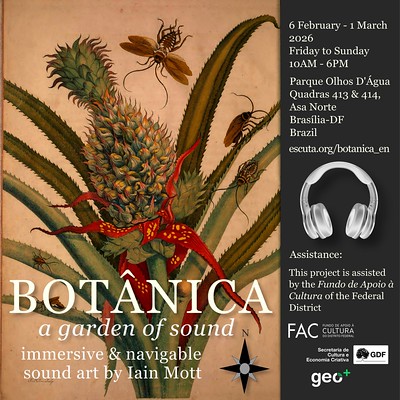
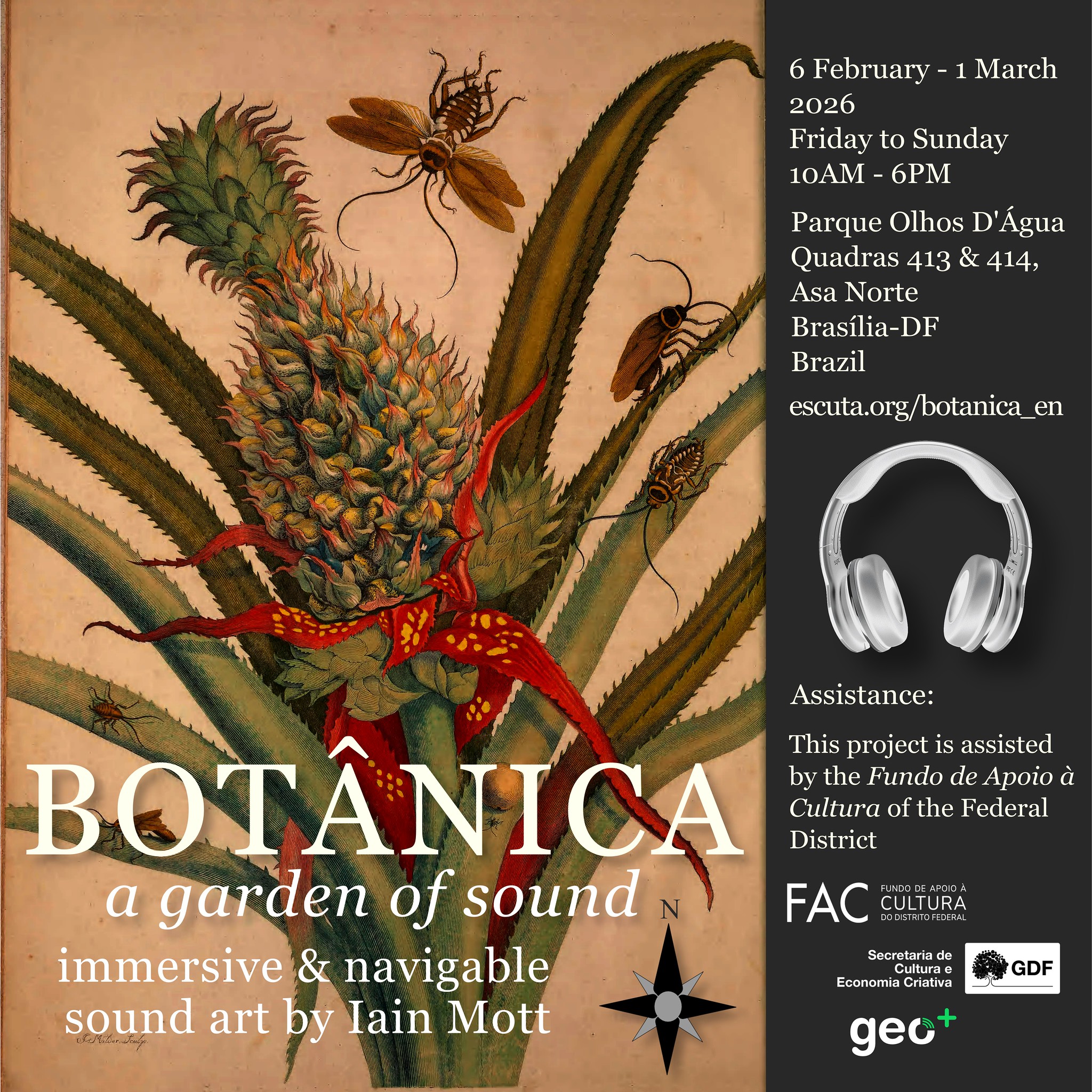
Botanica is a garden-based sound art project by Iain Mott. Members of the public, together with a guide, use headphones and a shoulder bag to explore an immersive sound composition overlaid on the landscape. The sounds heard are largely confected from nature and involve audio recordings from the cerrado of Brazil's central-west. As participants walk through the garden, their movements are tracked by high-resolution Real-Time Kinematic (RTK) GPS, allowing them to hear a variety of sounds precisely mapped to different locations.
The overlapping soundscapes encountered are three-dimensional, and head-tracking on the headphones delivers an interactive immersion responsive to the finest movements of the listener. Sounds may be fixed in space, acting like beacons, or may follow their own trajectory through the garden. The headphones are of an open type, allowing the natural sounds of the environment to blend with those of the overlay.
Botanica is presented as a sonic fantasy inspired by landscape, the biosphere, and the elements, and returned to the environment in a form to be explored in a specific setting: the garden, another fantasy of and for nature. It is a sound composition organised in space rather than time and as such interacts directly with the environment and with human presence.
Since the early 1990s, Iain Mott has been engaged in the spatial mapping of sound in various contexts. His 1998 work Sound Mapping, made with engineer Jim Sosnin and designer Marc Raszewski, is particularly relevant to the current project. Among the very first artworks to use GPS, Sound Mapping received an Honorary Mention at the Prix Ars Electronica in Linz, Austria.
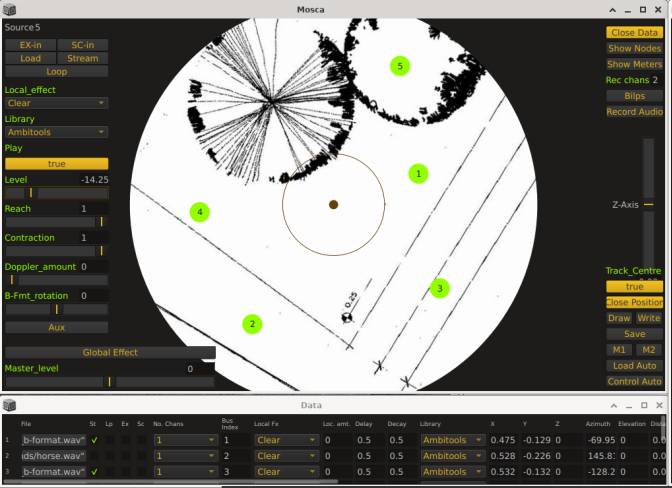
Botanica is an outcome of his research in the field of ambisonics (a form of surround sound first developed in the UK in the 1970s) and specifically the project Ambisonic Cerrado, which involves the use of ambisonic field recordings of the cerrado in theatrical contexts and installations. His open-source software Mosca (an ambisonic extension class for the SuperCollider music language) was created in this research and forms the technical basis of Botanica.
This project is assisted by the Fundo de Apoio à Cultura of Brazil's Federal District.